Recertification Frequency for Suspended Platform Safety Locks: A Complete Guide
Wiki Article
Every piece of equipment on a suspended platform (swing stage) is critical, but none more so than the safety lock (also known as the fall arrest or overspeed brake). It's the final line of defense if a hoist rope breaks. Because it sits idle until an emergency, strict maintenance and certification routines are required to ensure it works when needed.
The frequency for re-certifying a suspended platform safety lock typically follows a multi-tiered timeline depending on how it’s viewed—ranging from daily functional tests to mandatory annual or semi-annual factory calibrations.
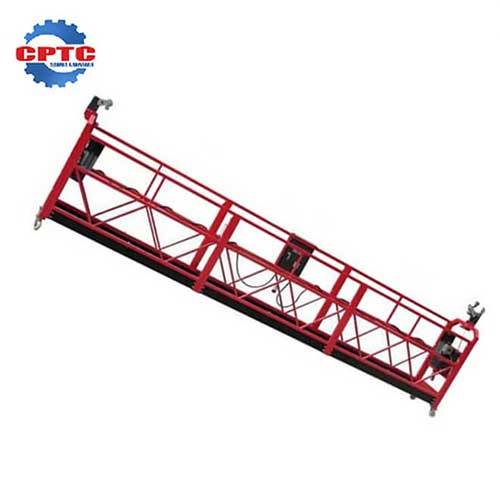
- ZLP Series Suspended Platform
Professional & Factory Re-Certification Frequency
For full mechanical overhaul, calibration, and official documentation (what is formally meant by "re-certification"):
Every 6 to 12 Months (Industry Standard): In most major regulatory regions, a safety lock must be sent back to the manufacturer or an authorized service center for professional inspection, testing, and re-certification at least once every 12 months (and in many jurisdictions or heavy-use cases, every 6 months).
The "4 to 6 Month" Customary Calibration Rule: In global manufacturing hubs and dense urban environments, regulations often mandate that safety locks undergo dedicated precision testing or adjustment every 4 to 6 months of cumulative use, alongside a complete replacement or overhaul after 12 months.
Crucial Rule: If a safety lock is ever triggered during an actual overspeed or rope-failure incident, it must immediately be taken out of service and sent for professional re-certification before it can be used again—regardless of how recently it was last serviced.
The Full Inspection Hierarchy
Safety certification doesn't just happen once a year; it is part of a strict, tiered approach to job site safety:
Level of Inspection | Frequency | Who Conducts It? | What is Done? |
Pre-Shift Functional Test | Every day (before use) | The Operator / Site Competent Person | Testing the swing arm flexibility and simulating a manual lock to ensure the mechanism is not jammed with debris or grease. |
Periodic Maintenance | Every 1 to 2 months | Specialized Maintenance Personnel | Cleaning, internal lubrication check, and clearing any structural grit. |
Factory Re-Certification | Every 6 to 12 months (or post-incident) | Manufacturer / Authorized Service Center | Complete disassembly, replacing fatigued internal springs or worn rollers, recalibrating the locking speed, and issuing a new compliance tag. |
Why Safety Locks Require Frequent Recalibration
Unlike standard structural scaffolding, a safety lock is a precision mechanical instrument. On a construction site, it is constantly exposed to:
Concrete dust, wet paint, and abrasive grit that can clog the centrifugal flyweights or clamping jaws.
Internal spring fatigue (the torsion springs that trip the lock can weaken over time).
Worn internal rollers that fail to grip the wire rope with the exact tension required.
Note: Never attempt to disassemble or repair a safety lock's internal mechanism on the job site. Doing so instantly voids its safety certification and puts lives at risk.
Report this wiki page